Who we are: Our mission & vision
Our vision: To empower people to transform local and global communities by shifting from “me” thinking to “we” acting.
We measure the bottom line by the people empowered and the lives transformed. Living ME to WE means working together to create sustainable change, and making a difference with everything you do—from choosing travel that leaves a positive footprint on the planet to making purchases that give back.
Our mission: Inspire and enable people to do good through their everyday choices
ME to WE creates options for consumers like you, who want to make informed decisions about what you experience and buy, knowing your actions will help empower people and transform lives, making the world a better place.
Our charity partner
WE Charity is our charity partner and our best friend in changing the world. Using a highly effective model, ME to WE is structured to offset expenses and help provide pro bono services to WE Charity’s efforts at home and abroad. ME to WE donates half its net profits to support WE Charity, while the other half is reinvested to grow the mission of the social enterprise.
Learn more about WE Charity.
How we came to be: Our founding story
The beginnings of ME to WE
When brothers Craig and Marc Kielburger were in middle school, international travel experiences changed their lives and sparked the beginnings of the social enterprise ME to WE.
These trips shaped the early work of WE Charity, and also sparked a passion to take friends and other youth to volunteer overseas so they, too, could have similar life-changing experiences. In 1999, Craig and Marc incorporated a small company—Leaders Today—to run volunteer trips and leadership camps. This was the precursor of ME to WE.
Read more below on the history of ME to WE Trips.


“Inspired by Jeff’s early guidance, every ME to WE project is filtered through two lenses. First, it must do good in the world in and of itself. For instance, we create jobs in our trip locations, where we need local architects and engineers, chefs, drivers, interpreters and guides. And second, it must make money to fund the organization’s charitable projects. Revenue from trips is funneled back into WE Charity to fund development projects in those same communities. Every trip participant is part of the sustainable development process; you do good just by staying with us. Not only by mixing cement and laying bricks for a new school or water project, but because the cost of your trip itself helps to fund the very same projects you’re building.”
The spark
As WE Charity grew internationally, Craig and Marc Kielburger struggled to find a sustainable funding source. This problem came into sharp focus in 2006, while they were in Freetown Port, Sierra Leone, waiting for a shipment of medical supplies to support WE Charity development projects in that country. Waiting on the docks, the brothers watched other international charities, depleted of funds, prepare to ship out. One dejected aid worker explained why everyone was leaving: “When is the last time you saw a celebrity telethon for Sierra Leone?”
Charities often lurch from crisis to crisis, desperately trying to help during humanitarian emergencies, but rarely staying long enough to empower people to help themselves for the long term. Another humanitarian disaster had caught the wave of goodwill and it was time for many to move on. Craig and Marc realized they needed a new model to support the long-term charitable goals of WE Charity, as well as crucial behind-the-scenes needs that few wanted to fund, such as administration, research, and monitoring and evaluation activities.
The seeds of that new model lay in the trips that Leaders Today was operating.
In their search for a sustainable funding source for WE Charity, Craig and Marc were fortunate to be mentored by billionaire Jeff Skoll, eBay’s first president. Jeff encouraged the brothers to grow Leaders Today into a social enterprise, with a social mission at its heart that would turn a profit in order to provide a long-term, predictable source of funding to WE Charity.
Learn more about WEconomy.
ME to WE offers sustainable products and life-changing experiences that have forever changed the way consumers shop, travel and learn. And ME to WE helps sustain WE Charity. The funds ME to WE donates to WE Charity enable it to have an extremely low administration rate (around 10 percent) compared to other Canadian charities.
ME to WE also allows Craig and Marc, for the first time, to earn a salary. The brothers had always refused to be paid from the funds donated to WE Charity, and they’d been living on fellowships and scholarship money, as had many of the early WE Charity volunteers, who were so dedicated to its mission. Funding support from ME to WE enabled Craig and Marc to continue on as full-time employees for both organizations.
Read more about ME to WE and WE Charity’s relationship.
Social entrepreneurship
At the heart of ME to WE is our commitment to social entrepreneurship. WEconomy, a new book co-authored by Craig Kielburger, Holly Branson and Marc Kielburger, is an extraordinary guide to today’s new business world, helping others discover how to find meaning, make a living and change the world.
Learn more about WEconomy and read a sample chapter here.

Our social enterprise helped solidify the idea of purpose and profit, or in our case revenue, coming together to change the world.
ME to WE Artisans
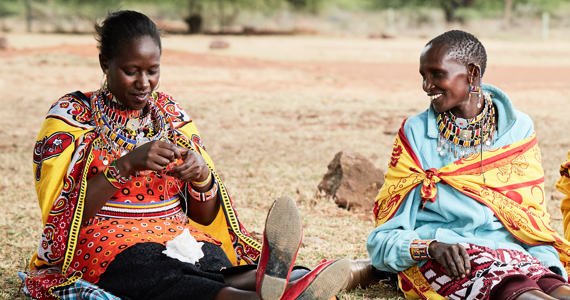
ME to WE Artisans is a line of original accessories handcrafted by artisans in WE Charity’s partner communities across the globe. It started with a vision: to not only create a way for talented artisans to earn the income they deserve, but to foster a collective of women empowering one another globally. ME to WE Artisans partners with artisans in Kenya and Ecuador, empowering each woman to build a brighter future for herself, her family and her community.
Founder and ME to WE CEO Roxanne Joyal was inspired to create ME to WE Artisans after meeting talented Maasai beaders forced to travel daily to small tourist markets flooded with similar products. There, they would sometimes sell their intricate beadwork at a loss.
Today, the mamas are able to earn twice as much as before—without giving up their traditional way of life.
Gathered under acacia trees with their young children in tow, the Maasai mamas bead using art forms passed down mother-to-daughter through generations. They turn their traditional handiwork into a livelihood.
ME to WE retail products, including ME to WE Artisans, also offer a Track Your Impact promise, to show consumers what their purchase provided to WE Charity. Through this model, consumers can see exactly what their dollars provided, and where the donation was delivered. For example, the purchase of a ME to WE bracelet might fund education for a child in Kenya for one year. Learn more about where you can shop ME to WE products that change lives here.
We wanted customers to purchase beautiful, handcrafted necklaces that would support mothers in rural Kenya. ME to WE Artisans would offer steady employment and small-business training for extremely marginalized women, a source of income to support their families. Plus, partial proceeds from the purchase of Artisans’ goods would support development programs in the very region where the women live and work. We call this a ‘closed-loop system’ because profits from purchases of socially conscious products made in our partner communities return to those same communities.

What is now ME to WE Trips began when Craig and Marc took the first young travelers to build WE Charity’s first schools in India, Nicaragua and Kenya. Craig and Marc started these international volunteer trips because they couldn’t find a provider that would take youth under 18. When they asked the WE Charity Board of Directors to set up a volunteer travel program, the board politely declined. Because of the laws in Canada, a Board of Directors would have had to assume all risks and potential liability if something went wrong. For our Board of Directors, some of whom are notable philanthropists, it was too great a liability to assume. And according to Canadian law, if a participant pays for themselves or a family member to participate on an international volunteer trip (excluding the rare case when philanthropists provide scholarships for someone else), it is a “personal benefit,” rather than a charitable activity eligible for a tax receipt.
At that point in time, the designation “social enterprise” did not exist.
So in 1999, the brothers incorporated a small company to run volunteer trips and leadership camps. They called it Leaders Today, and it was the precursor to ME to WE. Any profits at the end of the year were given to children as scholarships.
Today, ME to WE offers trips to eight destinations in our partner countries around the world, with experiences for individuals, youth, schools, families and companies.
In the pink hills of India’s Aravalli Mountains, you’ll be welcomed into village homes to make chapatti with the local women. In the Amazon’s cloud forest in Ecuador, you’ll visit a cocoa farmer to help with the harvest. In Kenya’s Maasai Mara, you’ll walk with the mamas to the Maasai River to collect water. WE has an ongoing partnership with each community, so travelers are welcomed like friends and partners in social impact, not temporary visitors.
Read more about ME to WE Trips.